
Rear Disc Brakes on a Classic Mustang: Myths, Bad Advice, and Reality
If you’ve spent any time on Mustang forums, you’ve probably seen the same arguments repeated over and over:
Rear discs only add 5% braking
The rear of a Mustang is too light to matter
Drum brakes work just fine
It’s not worth the cost
Most of these opinions come from people repeating what they’ve heard, not from actually running a properly set up rear disc system.
Let’s break this down with some real-world context.
The “Rear Is Too Light” Argument
This is probably the most common argument against rear disc brakes, and it’s based on a misunderstanding of how these cars actually behave.
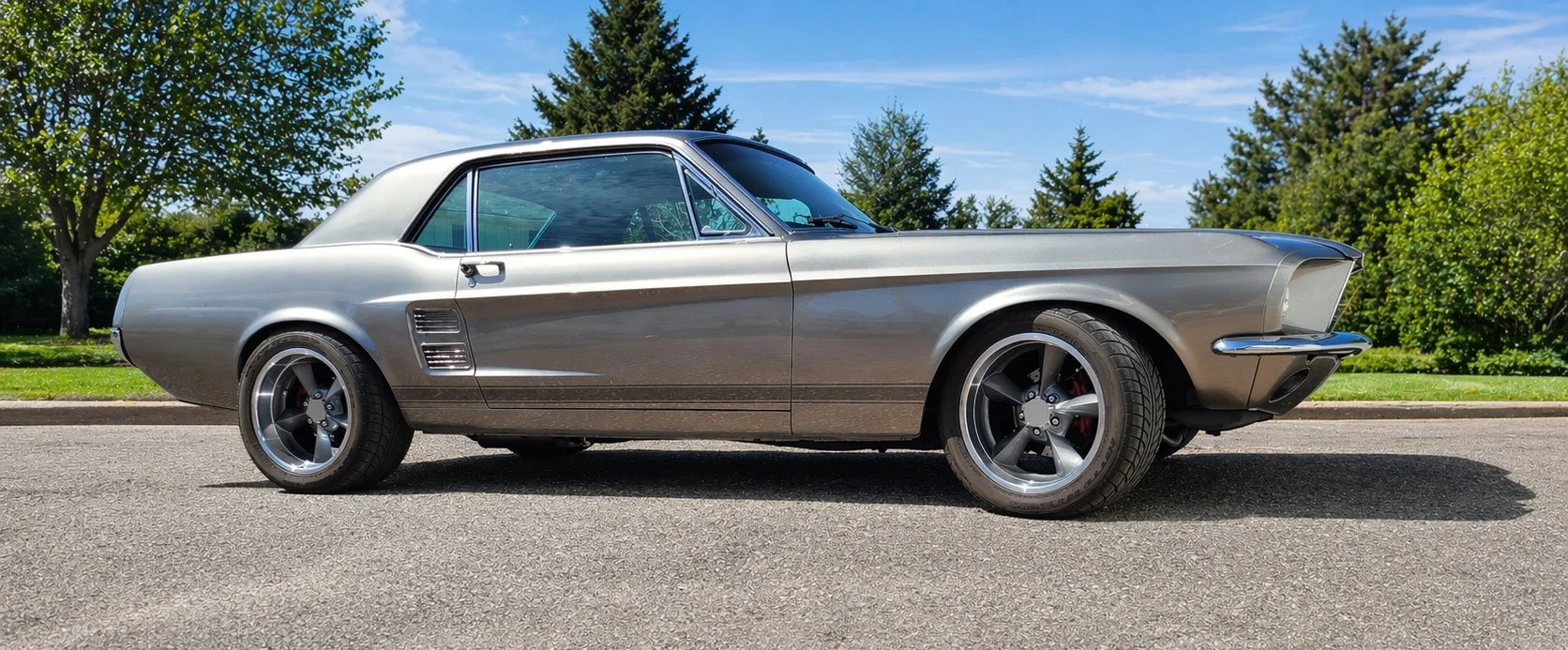
A typical early Mustang sits somewhere around 54–57% front weight and 43–46% rear. That’s not an extreme imbalance, and it’s actually very similar to a lot of modern performance cars. Modern Mustangs fall in the 53/47 range.
On top of that, most cars today aren’t stock. Once you start adding aluminum heads, intake, water pump, and radiator, or even moving the battery to the trunk, it’s very easy to pull 100 pounds or more off the front of the car. That alone shifts the balance closer to something approaching 50/50.
Even on cars that are still front-heavy, rear brakes still play an important role. They help stabilize the car under braking, reduce the load on the front brakes, and keep the system balanced.
If rear weight alone determined whether disc brakes were useful, then modern front-wheel-drive cars wouldn’t run rear discs. Something like a Mini Cooper S has very little weight over the rear axle, yet still uses rear discs for consistency and control.
Under braking, weight does transfer forward, but that doesn’t mean the rear brakes are irrelevant. It means they need to work properly as part of the system.
The “Only 5% More Braking” Claim
This one gets repeated a lot, and while the front brakes do carry the majority of the braking load, it completely misses the point.
Yes, the front brakes do most of the stopping. That’s basic physics.
But rear disc brakes are not only about adding raw stopping power. They improve consistency, modulation, heat management, and overall brake balance.
That’s what actually makes a car feel better and more predictable under braking.
The “I Can Lock Up My Drums” Argument
Another thing that comes up all the time is:
“I can already lock up my rear drums, so why would I need anything better?”
This sounds logical at first, but it completely misses how braking actually works.
Locking up the brakes is not a sign of good performance. It’s the opposite.
Once a tire locks up, it stops rotating and starts sliding. At that point:
You lose traction
You lose control
Braking effectiveness drops
A sliding tire has less grip than a rotating tire at the limit of adhesion. That means a locked brake is no longer braking efficiently.
What you actually want is:
Maximum braking force without lockup
Smooth, predictable modulation
A system that lets you stay right at the limit of traction
This is where disc brakes help.
Because they are more consistent and easier to modulate, it’s easier to apply braking force right up to the limit without crossing into lockup.
Drum brakes, with their self-energizing behavior, can make it easier to accidentally lock the rear brakes, especially as conditions change.
So being able to lock up your rear drums is not proof that they’re working well. It’s usually a sign that the system is not well balanced.
Where Drum Brakes Fall Short
Drum brakes work, but they come with some inherent limitations.
They trap heat inside the drum, which makes them more prone to fade under repeated use. They rely on a self-energizing effect that can make braking feel inconsistent depending on temperature and wear. They also tend to hold water, which can reduce braking effectiveness in wet conditions.
They were a perfectly acceptable solution when these cars were new, but they’re not ideal for a modernized or performance-oriented build.
The Real Benefits of Rear Disc Brakes
Heat Management
Disc brakes are exposed to airflow, which allows them to cool much more effectively. This makes a noticeable difference during repeated braking, long downhill grades, or any kind of aggressive driving.
Drum brakes simply can’t dissipate heat the same way, and performance drops off as temperatures climb.
Wet Weather Performance
Disc brakes shed water quickly and maintain friction even in wet conditions.
Drum brakes can trap water inside the drum, which reduces braking effectiveness until enough heat builds up to dry them out.
Consistency and Brake Feel
Disc brakes provide a more linear and predictable response. What you put into the pedal is what you get out of the system.
Drum brakes can feel inconsistent because of how they generate braking force internally.
Reduced Brake Fade
Because disc brakes manage heat better, they are much more resistant to fade.
This becomes noticeable any time the brakes are used repeatedly, whether that’s spirited driving or extended downhill sections.
Unsprung Weight and Simplicity
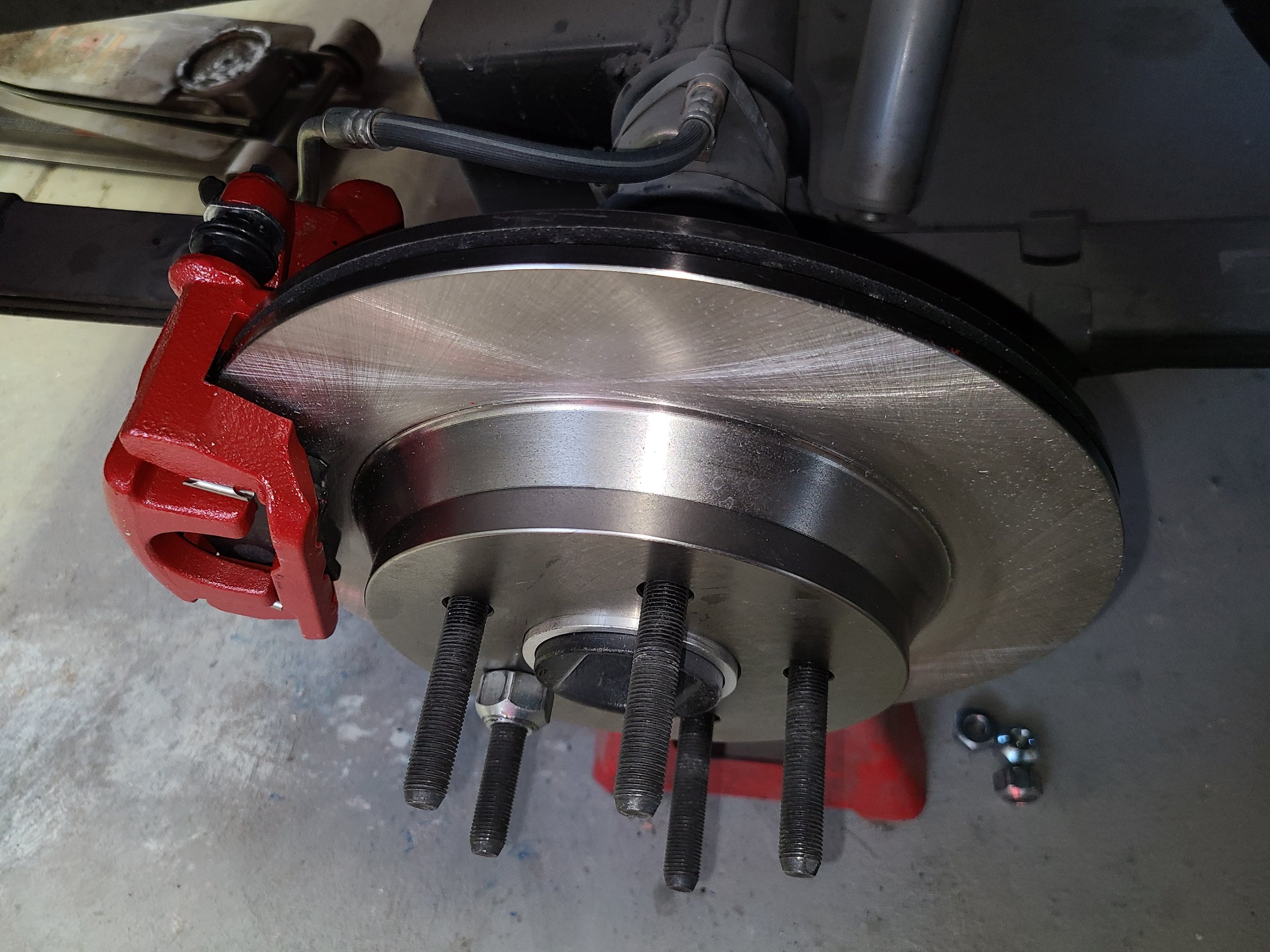
Drum brake assemblies are large, heavy, and made up of a lot of small components.
Disc setups are typically lighter and much simpler. That reduction in unsprung weight helps suspension performance, even if it’s not immediately obvious.
Maintenance
Servicing drum brakes involves springs, adjusters, and a lot of small parts that can be frustrating to deal with.
Disc brakes are straightforward. Pads, bolts, and you’re done.
That alone is a big advantage if you actually work on your own car.
Appearance
This is subjective, but it still matters.
If you’re running modern wheels or building a clean restomod, drum brakes look out of place. A disc setup simply fits the overall look better.
The Real Takeaway
Rear disc brakes are not about dramatically increasing stopping power.
They are about improving how the system behaves as a whole.
You get better consistency, better heat management, improved performance in real-world conditions, and a system that works more like modern cars.
If you’re keeping a car completely stock and driving it casually, drum brakes will get the job done.
But if you’re upgrading the car, driving it harder, or trying to build something that performs well, feels predictable, and brakes safely, rear disc brakes are a logical part of that system.
Final Thought
Most of the arguments against rear disc brakes fall apart once you look at how these systems actually work and what they cost in the real world.
At that point, it becomes less about opinion and more about what kind of car you’re trying to build.